


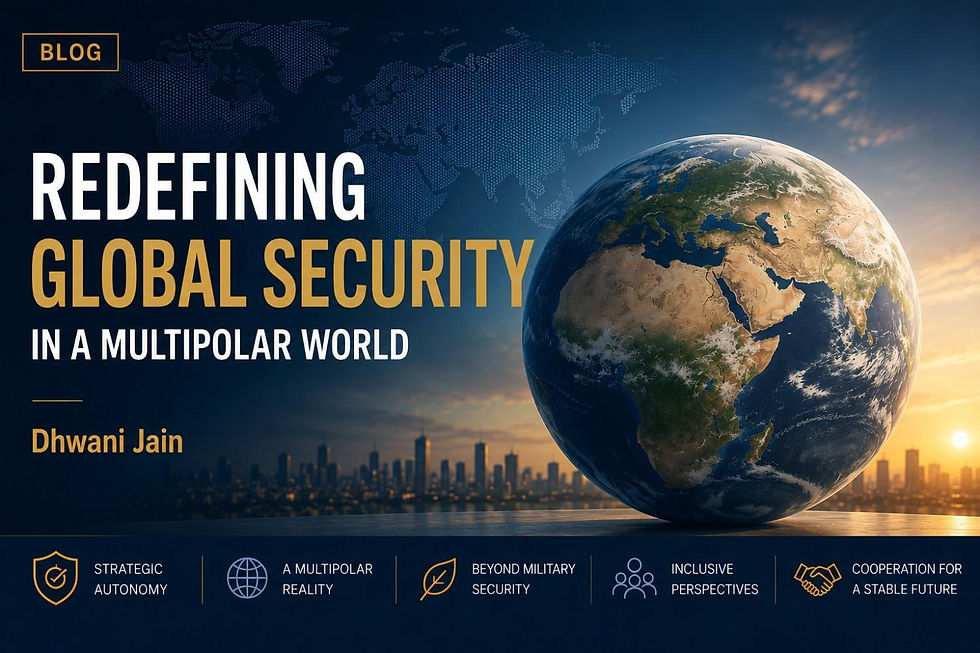
Redefining Global Security in a Multipolar World

"Every nation has the right to protect its interests. The real question is: who gets to define what those interests should be?"
That question lies at the heart of the changing global order.
For much of the post-World War II era, international security was understood through a largely Western framework. Wars in Europe reshaped global politics. NATO became synonymous with collective security. International institutions reflected a consensus led by a handful of powerful nations, and the language of security—its threats, priorities, and even its moral boundaries—was shaped predominantly by the West.
Today, that consensus is being questioned—not because the importance of security has diminished, but because the world has changed.
Power is no longer concentrated in a few capitals. Economic influence is shifting eastward. New centres of innovation are emerging. The Global South is demanding a greater voice in global governance. In this changing landscape, one question has become increasingly significant:
Can global security continue to be defined by the experiences and priorities of a few, or must it evolve to reflect the realities of a multipolar world?
Recent remarks by India's External Affairs Minister, Dr. S. Jaishankar, at the Kultaranta Talks in Finland brought this debate into sharp focus. Responding to criticism over India's purchase of Russian oil, he reminded his audience that while Europe often questions India's strategic choices, European-origin weapons have historically found their way into Pakistan, directly affecting India's own security.
Many viewed the remarks as a criticism of Europe.
Perhaps they were something more profound.
They reflected a growing confidence in India's foreign policy—a confidence rooted not in confrontation, but in the belief that every sovereign nation has the right to define its own security based on its history, geography, and national interest.
Security Has Never Been Uniform
One of the greatest misconceptions in international relations is the assumption that security is experienced uniformly across the world.
It is not.
For Europe, Russia's invasion of Ukraine fundamentally altered strategic thinking. For India, security has never been episodic. Since Independence, India has confronted wars, unresolved borders, cross-border terrorism, maritime challenges, and an increasingly complex regional environment.
These realities shape India's worldview.
When India speaks of security, it does not speak only of military alliances. It speaks of territorial integrity, economic resilience, technological sovereignty, energy independence, maritime stability, and the ability to make sovereign decisions without external coercion.
Security, for India, is inseparable from development.
Strategic Autonomy Is Not Neutrality
India's policy of strategic autonomy is often misunderstood as an attempt to avoid taking sides.
In reality, it is about retaining the ability to take decisions independently.
India partners with the United States in the Indo-Pacific, strengthens defence cooperation with France, maintains long-standing strategic ties with Russia, expands engagement with Africa and the Gulf, and deepens partnerships across the Indo-Pacific.
To some, this appears contradictory.
To India, it is pragmatic.
In an era where geopolitical competition is intensifying, dependence on a single power creates vulnerability. Strategic autonomy is therefore not a sign of hesitation—it is an exercise in strategic responsibility.
Security in the Twenty-First Century
The meaning of security itself is changing.
Military strength remains essential, but it is no longer sufficient.
A cyberattack can paralyse critical infrastructure. Supply-chain disruptions can halt economies. Artificial intelligence is redefining national competitiveness. Climate change influences migration, food systems, and geopolitical stability. Energy insecurity can affect millions long before conflict reaches the battlefield.
India has consistently argued that development, resilience, and technology are now central pillars of national security.
Its leadership during the G20 Presidency reflected this broader vision—placing Digital Public Infrastructure, climate action, resilient supply chains, and the concerns of the Global South alongside traditional strategic issues.
This represents an expansion of the security discourse rather than a rejection of it.
From Rule-Taker to Rule-Shaper
Perhaps the most significant transformation in India's foreign policy is psychological.
For decades, emerging economies often adapted to international norms largely designed elsewhere.
Today, India increasingly seeks to shape those norms.
Whether through initiatives such as the International Solar Alliance, its advocacy for reform of multilateral institutions, or its emphasis on strategic autonomy, India is contributing ideas rather than merely responding to them.
This is not about replacing one dominant worldview with another.
It is about ensuring that the international order reflects the diversity of experiences that define today's world.
A rules-based order derives its legitimacy not simply from the rules themselves, but from their consistent application and universal acceptance.
A Multipolar World Requires a Multipolar Mindset
The emergence of a multipolar world demands more than a redistribution of economic and military power.
It requires a redistribution of intellectual leadership.
Security cannot remain a concept defined primarily by one region's experiences.
Europe's security concerns are legitimate. America's security concerns are legitimate.
So are those of India, Africa, Southeast Asia, Latin America, and every nation navigating its own unique strategic realities.
The challenge before the international community is not to determine whose security matters most.
It is to recognise that enduring global stability can only be built when every nation's security concerns are treated with equal legitimacy.
India's Emerging Strategic Voice
India's rise is often measured through GDP, defence capability, technological innovation, or demographic strength.
These are important indicators.
Yet India's most enduring contribution to the twenty-first century may be something less tangible, but equally consequential.
It is helping redefine how the world understands security.
By arguing that energy security, technological resilience, economic stability, and strategic autonomy are integral to national security, India is expanding the global conversation beyond military alliances and geopolitical blocs.
The defining question of our time is no longer simply who possesses power. It is who helps shape the principles by which that power is exercised.
Increasingly, India is not asking for a seat at someone else's table.
It is helping redesign the table itself.
And that may prove to be its most significant strategic contribution to the emerging world order.


Comments